
Retirement can feel abstract when it’s decades away, and overwhelming when it’s suddenly around the corner. What matters most is knowing which moves to make right now — wherever you are.
The best time to start planning for retirement is now. Each decade of your working life presents distinct opportunities and tradeoffs. The strategies that make sense at 35 look very different from the ones that matter most at 55, and understanding those differences is the foundation of a retirement plan that actually works.
This guide walks through the key priorities for retirement planning in your 30s, 40s, 50s, and beyond — with a practical to-do list and pro tip for each decade.
Table of Contents
- Retirement Planning in Your 30s: Build the Foundation
- Retirement Planning in Your 40s: Accelerate and Reassess
- Retirement Planning in Your 50s: Intensify the Focus
- Retirement Planning in Your 60s and Beyond: Protect What You’ve Built
- Where HTG Fits In
1. Retirement Planning in Your 30s: Build the Foundation
Your 30s may not feel like prime retirement-planning territory — you might be managing student loans, buying a home, raising children, or juggling all three at once. But this decade is arguably the most powerful one for retirement savings, for one simple reason: time.
Thanks to compound growth, money invested in your 30s has 30 or more years to grow before you need it. Even modest contributions made consistently now can outpace much larger contributions made in your 50s. This is the decade to build habits and systems that will carry you forward.
To-Do List for Your 30s:
- Build an emergency fund of three to six months of living expenses before aggressively increasing retirement contributions. Without it, unexpected costs can force you to tap retirement accounts early and trigger penalties.
- Maximize tax-advantaged accounts. The most powerful thing you can do in your 30s is make full use of the accounts the IRS has designed to grow your money as tax-efficiently as possible:
- Enroll in your employer’s 401(k) or 403(b) and contribute at least enough to capture the full employer match. The 2026 401(k) contribution limit is $24,500 — at minimum, contribute whatever percentage triggers your employer’s maximum match. That match is part of your compensation, and leaving it unclaimed is leaving money behind. If your employer offers a Roth 401(k) option, it’s worth considering: you contribute after-tax dollars now in exchange for tax-free withdrawals later — a compelling trade-off when you’re earlier in your career and likely in a lower tax bracket than you will be at retirement. See our blog for an overview of each option.
- Open a Roth IRA if you’re eligible. Roth contributions are made with after-tax dollars, so your withdrawals in retirement are completely tax-free. The 2026 IRA contribution limit is $7,500, and income limits apply — the IRS phases out Roth eligibility for higher earners. Your 30s are often the ideal window before income potentially pushes you out of eligibility.

- Open and max out a Health Savings Account (HSA) if you’re enrolled in a high-deductible health plan (HDHP). The HSA offers triple tax advantages: contributions go in pre-tax, growth is tax-free, and withdrawals for qualified medical expenses are tax-free. The 2026 HSA contribution limit is $4,300 for individuals and $8,550 for families. Unlike an FSA, HSA funds roll over indefinitely — no use-it-or-lose-it pressure. If you can afford to pay medical expenses out of pocket now, consider investing your HSA balance and letting it compound; after age 65, you can withdraw for any reason penalty-free (non-medical withdrawals are taxed as ordinary income).
- Pay down high-interest debt. Carrying 20%+ interest on credit cards while earning 7–8% in investment returns is a losing equation.
- If you’re self-employed, explore a SEP-IRA or Solo 401(k), both of which allow for significantly higher contribution limits than a traditional IRA.
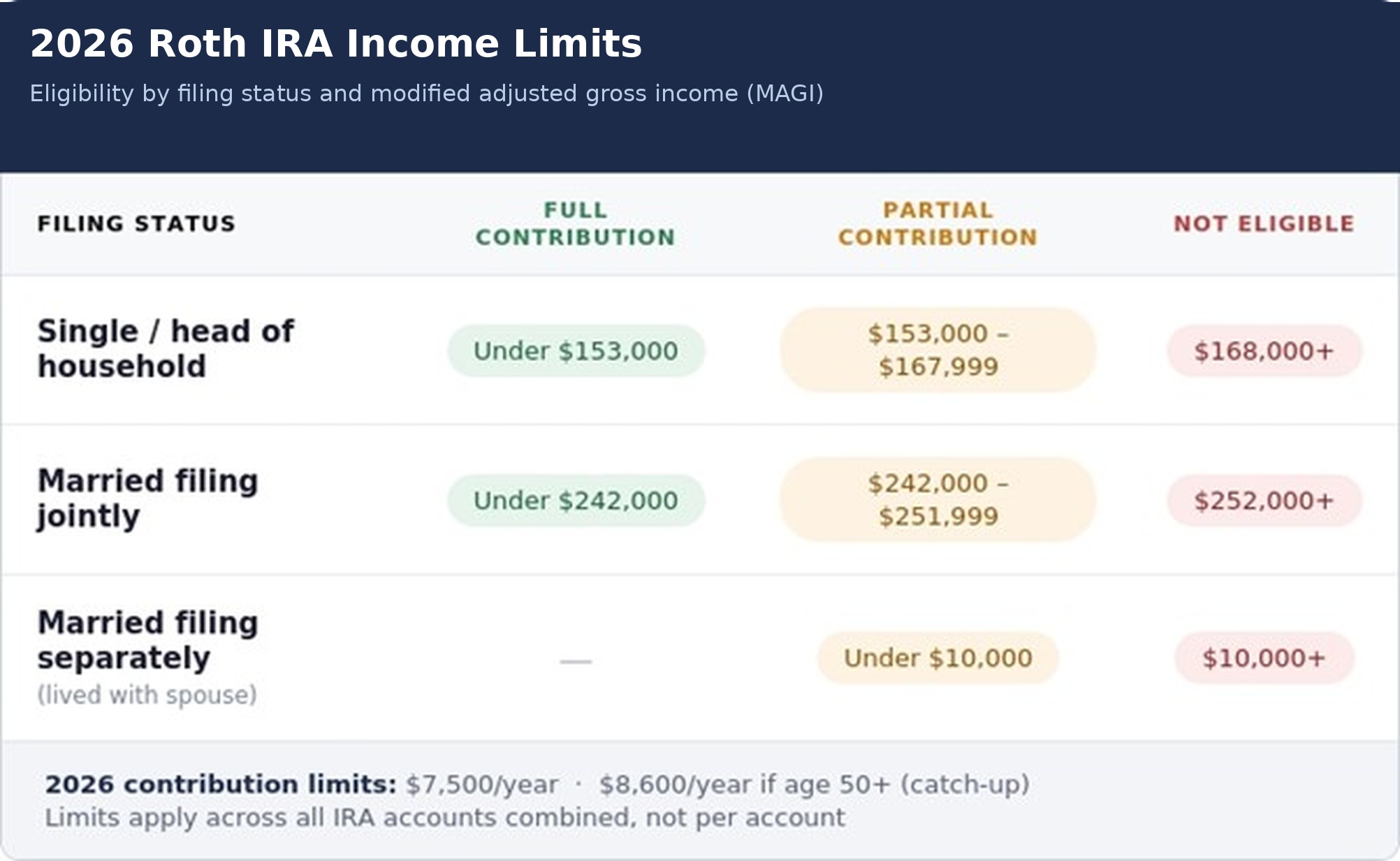
Pro Tip: Don’t wait until you feel financially “ready” to start investing. Automate a contribution — even a small one — so that saving happens before you have a chance to spend it. Increasing that contribution by just 1% per year as your income grows can make a remarkable difference over time.
2. Retirement Planning in Your 40s: Accelerate and Reassess
Your 40s are often a decade of peak earning power — and peak financial complexity. Mortgages, college savings, aging parents, career transitions: the competing demands on your income are real. But this is also the decade when retirement starts to come into clearer focus, and when the decisions you make carry serious long-term weight.
Knowing how to plan for retirement in your 40s means revisiting the assumptions you made earlier and stress-testing them against where you actually are.
To-Do List for Your 40s:
- Run a retirement projection. Use a financial planning tool or work with a CFP® to estimate whether your current savings rate puts you on track for your target retirement date and lifestyle. If there’s a gap, now is the time to address it — you still have 20+ years of runway.
- Increase your 401(k) contribution rate. The 2026 contribution limit for 401(k) plans is $24,500. If you haven’t been maximizing it, your 40s are the decade to push closer to that ceiling.
- Revisit your investment allocation. The aggressive, growth-heavy portfolio you built in your 30s may need to be rebalanced to include more diversification as your timeline shortens.
- Review your insurance coverage. Life insurance, disability insurance, and long-term care insurance all deserve a fresh look. Disability insurance in particular is often overlooked: your ability to earn an income is your most valuable asset.
- Be careful not to sacrifice retirement savings for college savings. If you have children approaching college age, keep your priorities straight: you can borrow for college; you cannot borrow for retirement.
Pro Tip: If your income allows, consider whether a Roth conversion strategy makes sense. Converting pre-tax IRA assets to Roth during your 40s — before required minimum distributions begin — can meaningfully reduce your future tax burden in retirement. This is a strategy worth modeling with a financial advisor.
3. Retirement Planning in Your 50s: Intensify the Focus
Your 50s are when retirement transitions from a distant goal to a real timeline. Planning in this decade often means shifting from accumulation mode to planning mode — thinking carefully about when to retire, what income sources you’ll have, and how to manage the transition.
This is also the decade when the IRS gives you additional tools: catch-up contributions.
To-Do List for Your 50s:
- Take full advantage of catch-up contributions. Once you turn 50, the IRS allows you to contribute an additional $8,000 per year to your 401(k) above the standard $24,500 limit, and an additional $1,100 to an IRA above the standard $7,500 — for a combined maximum of $41,100 across both accounts in 2026. These catch-up provisions exist precisely for this stage of life.
- Eliminate or significantly reduce major debt. Entering retirement carrying a mortgage or other large liabilities raises the income you’ll need every month and reduces your flexibility. Your 50s are the decade to make aggressive progress — ideally arriving at retirement with the mortgage paid off or a clear plan to do so shortly after.
- Refine your retirement timeline. “Someday” needs to become a date. When do you actually want to retire? The answer shapes everything — how many years of savings you need, when to claim Social Security, when to enroll in Medicare, and how aggressively to invest in the years remaining.
- Start planning for healthcare costs. Healthcare is one of the most consistently underestimated expenses in retirement. A 65-year-old couple retiring today can expect to spend well over $300,000 on healthcare throughout retirement — not including long-term care. Factor in premiums, out-of-pocket costs, and the gap between your retirement date and Medicare eligibility at 65. If you’re considering long-term care insurance, now is the time to look in earnest; every year you delay can mean higher premiums or fewer options.
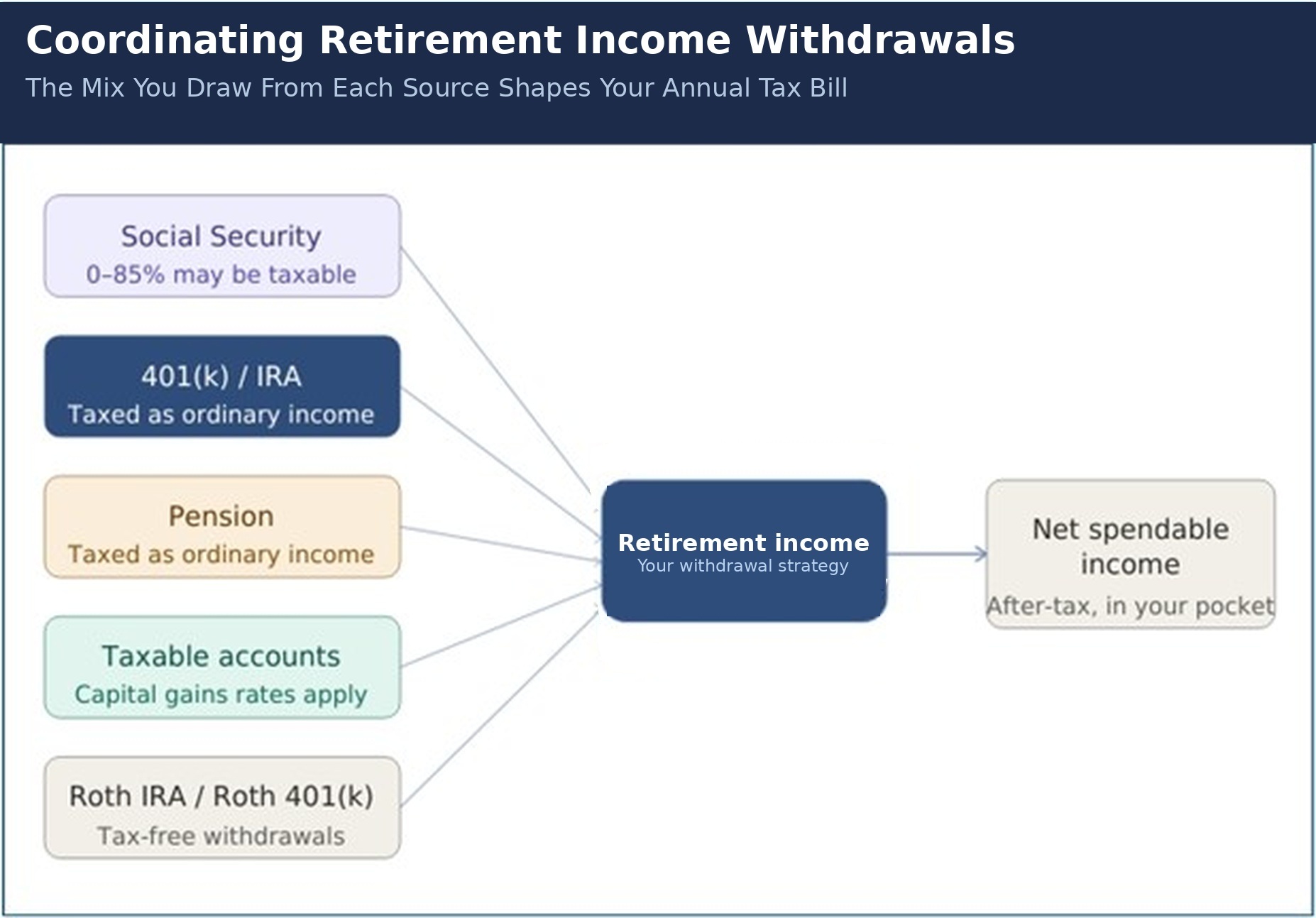
- Create a projected retirement income picture. Map out every source of income you expect in retirement: Social Security, 401(k) and IRA withdrawals, any pensions, and taxable investment accounts. Understanding how these sources interact — and how they’ll be taxed — is foundational to a sustainable withdrawal strategy.

Pro Tip: Your 50s are an excellent time to stress-test your retirement plan against real risks: a market downturn in the first years of retirement, an unexpected health event, or a longer retirement than you planned for. Building flexibility into your plan now — rather than assuming everything goes according to schedule — is one of the most valuable things you can do.
4. Retirement Planning in Your 60s and Beyond: Protect What You’ve Built
Retirement planning in your 60s and beyond shifts from growing your nest egg to making it last. The decisions you make in the years just before and after retirement, sometimes called the “retirement red zone”, can have a disproportionate impact on whether your savings sustain you for 20 or 30 years.
Planning in your 60s means thinking less about returns and more about income, taxes, and risk management.
To-Do List for Your 60s and Beyond:
- Use the super catch-up if you’re between 60 and 63. A higher catch-up limit now applies for this age group — you can contribute an additional $11,250 (in 2026) above the standard limit, bringing your total to $35,750 in employee contributions for the year. These provisions were designed specifically for workers in the final stretch before retirement.
- Think carefully about Social Security timing. Claiming at 62 reduces your benefit permanently; waiting until 70 maximizes it. For married couples, coordinating claiming strategies can significantly increase lifetime benefits. The Social Security Administration’s online tools can help you model different scenarios.
- Develop a withdrawal sequence strategy. In retirement, you’ll likely have money in taxable accounts, tax-deferred accounts (traditional IRA, 401(k)), and Roth accounts. How much you pull from each in any given year shapes your tax burden — a thoughtful approach to coordinating those withdrawals can meaningfully extend your portfolio’s longevity.
- Understand Required Minimum Distributions (RMDs). Once you reach your required beginning age, the IRS requires you to begin taking minimum withdrawals from most tax-deferred retirement accounts. That age depends on when you were born: 73 for those born between 1951 and 1959, and 75 for those born in 1960 or later under SECURE Act 2.0. Failing to take your RMD triggers a significant penalty. See our complete guide: Required Minimum Distributions: RMD Rules, Deadlines, and Mistakes to Avoid.
- Enroll in Medicare. You become eligible at 65. Missing your initial enrollment window can result in permanent premium penalties for Part B and Part D. If you’re still working and covered by an employer plan, understand how that affects your Medicare timeline.
- Review your estate plan. A current will, healthcare proxy, durable power of attorney, and beneficiary designations on all retirement accounts are essential. Beneficiary designations supersede your will — an outdated designation can have unintended consequences.
- Consider a Qualified Charitable Distribution (QCD) strategy. If you’re charitably inclined and age 70½ or older, a QCD allows you to donate directly from your IRA to charity — satisfying your RMD obligation without adding to your taxable income.
Pro Tip: Longevity risk — the risk of outliving your money — is one of the most underestimated challenges in retirement planning. With life expectancies continuing to increase, a 65-year-old couple today has a meaningful probability that at least one partner will live into their 90s. Plan for a longer retirement than you think you’ll need.
5. Where HTG Fits In
Retirement planning isn’t a single decision — it’s a decades-long process that evolves as your life does. At HTG Advisors, our CERTIFIED FINANCIAL PLANNER® professionals work with clients at every stage: building a foundation in their 30s, navigating complexity in their 40s and 50s, and transitioning into retirement with confidence in their 60s and beyond.
We integrate retirement planning with investment management, tax planning, and estate planning to create a cohesive strategy — not a collection of separate decisions made in isolation.
Whether you’re just starting out or approaching the finish line, we can help you understand where you stand and what to do next.