
When you sell an investment for more than you paid for it, the profit is called a realized capital gain — and the IRS wants its share. Understanding how these gains are taxed is one of the most powerful levers investors have for protecting their wealth.
The good news: with the right strategy, you can significantly reduce your tax burden, both legally and intentionally. HTG Advisor, Travis Hood, CPA/PFS™, breaks down how capital gains are taxed and the strategies long-term investors can use to manage that tax exposure.
Table of Contents
What Is a Realized Capital Gain?
A capital gain becomes realized the moment you sell an asset — a stock, mutual fund, real estate, or other investment — for more than your cost basis (what you originally paid, including fees and adjustments). With real estate, for example, capital improvements like a renovation or addition increase your basis and reduce your eventual taxable gain, whereas routine repairs don’t.
Until you sell, gains are considered unrealized, or “paper gains,” and are not taxable. This distinction is important: you control when you trigger a taxable event.
Short-Term vs. Long-Term: The Critical Difference
How long you hold an asset before selling determines which tax rate applies, and the difference is substantial.
Short-Term Capital Gains apply to assets held for one year or less. These gains are taxed as ordinary income, meaning they’re subject to your regular federal income tax bracket, potentially as high as 37%.
Long-Term Capital Gains apply to assets held for more than one year. These gains receive preferential tax rates:

Head of household filers have a 0% ceiling of $66,200, with the 20% rate beginning at $579,601. Married filing separately mirrors single filer thresholds up to $49,450, with the 20% rate starting at $306,851. Consult your tax advisor for your specific situation.
Pro tip: simply holding an investment for more than 12 months before selling can cut your tax rate dramatically, and for 2026, thresholds rose roughly 2–3% from 2025 due to inflation adjustments, giving more investors room within the lower brackets.
The Net Investment Income Tax (NIIT)
Higher-income investors should be aware of an additional 3.8% surtax on net investment income. This applies to individuals with modified adjusted gross income (MAGI) above $200,000 (or $250,000 for married couples filing jointly). This can push the effective capital gains rate to 23.8% at the top bracket.
The Stacking Effect: How Ordinary Income Impacts Your Capital Gains Rate
One of the most common planning traps we see is assuming that ordinary income and capital gains operate in completely separate worlds. The reality is they’re deeply connected, and understanding this relationship can produce significant tax savings.
Long-term capital gains and qualified dividends enjoy preferential rates (0%, 15%, 20%), but here’s the critical detail: ordinary income fills your tax brackets first, pushing your qualified income higher into the rate structure. Think of it like a ladder: ordinary income claims the bottom rungs, forcing your capital gains to start climbing from a higher point.
It’s a one-way street. While ordinary income pushes capital gains into higher brackets, the reverse is not true. Your qualified dividends and long-term capital gains have zero impact on which brackets your ordinary income falls into. This asymmetry is essential for strategic planning.
A Real-World Example (Married Couple, 2026)
Consider a married couple filing jointly with $400,000 in qualified dividends and long-term capital gains (LTCG).
In Scenario 1, that’s their only income, so a large share of the gain lands in the 0% bracket. In Scenario 2, the couple also completes a $200,000 Roth conversion — ordinary income that fills the lower brackets first and pushes the same $400,000 of gains higher up the ladder:
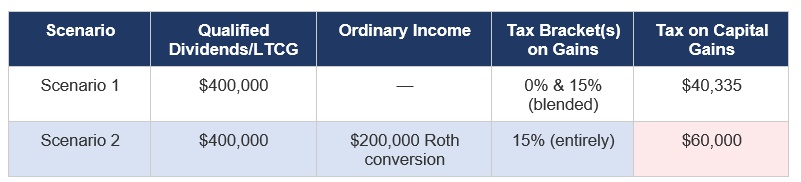
Notice what happened: the capital gains tax jumped by nearly $20,000, even though the capital gains income didn’t change at all. The Roth conversion pushed a portion of the qualified income out of the 0% bracket into the 15% bracket.
Note: This example excludes the 3.8% Net Investment Income Tax and ordinary income taxes on the Roth conversion for simplicity.
Pro tip: Before executing Roth conversions, realizing capital gains, exercising stock options, or taking other income-generating actions, model how the stacking effect will impact your overall capital gains tax. What appears to be a straightforward ordinary income decision can result in a significantly higher effective tax rate than anticipated. Comprehensive tax planning requires looking at your complete income picture, not just individual line items in isolation.
Key Strategies for Long-Term Investors
1. Hold for the Long Term (More Than One Year)
This is the simplest and most impactful strategy. Before selling any winning position, check whether you’re just days or weeks away from crossing the one-year threshold. A short wait could mean a significantly lower tax rate.
2. Tax-Loss Harvesting
If you have investments that have declined in value, selling them to realize a loss can offset capital gains elsewhere in your portfolio. Losses can offset gains dollar-for-dollar, and up to $3,000 of excess losses can offset ordinary income each year. Unused losses carry forward indefinitely. Just be mindful of the wash-sale rule, which disallows a loss if you repurchase the same or substantially identical security within 30 days before or after the sale.
Related reading: Three Tax-Smart Techniques for Managing Portfolios
3. Asset Location
Where you hold your investments matters. Consider placing tax-inefficient assets (such as bonds, REITs, and actively managed funds that generate short-term gains or income) in tax-advantaged accounts like IRAs or 401(k)s. Hold tax-efficient, long-term-appreciation investments in taxable brokerage accounts.
4. Utilize Tax-Advantaged Accounts
Investments held in a Traditional IRA, Roth IRA, or 401(k) grow without triggering capital gains taxes. In a Roth account, qualified withdrawals are completely tax-free, making these accounts particularly powerful for long-term compounding.
5. Charitable Giving of Appreciated Assets
Donating appreciated securities directly to a qualified charity, rather than selling them first, allows you to avoid capital gains tax entirely on the appreciation, while still receiving a charitable deduction for the full fair market value. This is one of the most tax-efficient giving strategies available.
Related reading: Smart Charitable Giving Strategies Under the One Big Beautiful Bill Act
6. Opportunity Zone Investments
Investing realized gains in a Qualified Opportunity Zone (QOZ) fund can defer and potentially reduce your capital gains tax liability. This program was made permanent and significantly overhauled by the One Big Beautiful Bill Act (OBBBA) in 2025, so the specific deferral and basis step-up rules now depend on when you invest. Gains held in a QOZ fund for 10+ years may be eligible for exclusion from tax on appreciation in the fund itself. These are complex vehicles, so seek professional guidance before investing.
7. Strategic Timing Across Tax Years
If you anticipate being in a lower tax bracket next year due to retirement, a career transition, or other factors, it may make sense to defer a sale to that year. Conversely, if you expect higher income in the future, accelerating a gain into the current year could be beneficial.
A Note on State Taxes
Federal rates are only part of the picture. Most states also tax capital gains, often as ordinary income. Depending on where you live, your combined federal and state rate could be considerably higher. This makes proactive planning even more important.
The Bottom Line
Capital gains taxes are one of the most controllable costs in your investment plan, but only if you’re intentional. Timing, holding periods, asset location, and tax-loss harvesting are all tools that can work together to preserve more of your wealth over time.
As always, tax laws change, and individual circumstances vary. We encourage you to reach out to discuss how these strategies apply to your specific situation. Smart tax planning isn’t about avoiding taxes — it’s about making sure you’re not paying more than your fair share.