This guide, prepared by HTG advisor Sonya Ziolkowski, CFP®, provides a comprehensive overview of Roth conversions and the considerations involved in determining whether one is appropriate for your goals and circumstances.
The Roth IRA is one of the most effective retirement savings vehicles available: income tax‑free growth, income tax‑free distributions, and income tax‑free inheritance for your beneficiaries. A Roth conversion is how you get money that’s currently sitting in a tax‑deferred account into that environment. The catch: you may owe ordinary income tax on the amount you convert, in the year you convert it.
Many individuals have never had the option to contribute directly to a Roth IRA. For example, they may have been phased out due to income eligibility requirements. For these individuals, they are faced with the decision: “does it make sense to perform a Roth conversion and take a tax hit now to reap the longer‑term benefits?”
A Roth conversion lets you trade a tax bill today for the chance to never pay tax on that money, or its growth, again. For the right person, in the right year, it can be one of the most powerful moves in a retirement plan. For the wrong person, or in the wrong year, it can be an expensive mistake. Here’s how the strategy actually works and where the potential upside comes in.
The Process and Components of a Roth Conversion
A Roth conversion involves two accounts — a Traditional IRA and a Roth IRA — and one deliberate action that moves money between them. Below, we outline what each account is, then walk through what actually happens when you convert.
Traditional IRA
A retirement account that can hold pre‑tax and after‑tax contributions, up to an annual limit; for 2026 these limits are $7,500, or $8,600 if you’re 50 or older. Money grows tax‑deferred inside the account, but the IRS eventually requires you to start withdrawing it through Required Minimum Distributions (RMDs), starting at age 73 if you were born between 1951 and 1959, or age 75 if you were born in 1960 or later. Those RMDs are taxed as ordinary income whether you need the cash or not. Pre‑tax contributions and growth rolled over from an old employer plan (401(k), 403(b), etc.) can also live here; in this case, it’s sometimes referred to as a “Rollover IRA.”
Roth IRA
A retirement account funded with after‑tax dollars, up to the same annual limit — in 2026, $7,500 or $8,600 if you’re 50 or older. Earnings grow tax‑free, qualified distributions come out tax‑free, and the IRS does not require RMDs from a Roth IRA during your lifetime, meaning the money can keep growing tax‑free for as long as you want it to.
A Roth conversion simply moves dollars from your traditional IRA into your Roth IRA.
The tax implication: The Roth conversion generates a Form 1099‑R that flows onto your tax return for that year. Depending on your existing IRA basis and account balances, anywhere from 0% to 100% of the converted amount may be taxable as ordinary income — see the pro‑rata rule. Keep the Roth conversion deadline in mind: the transaction must be completed by December 31 of the tax year you want it to count for. There’s no extension, even if you file your taxes later.
Pro tip: There is no dollar limit on how much you can convert in a given year, because unlike contributions, conversions aren’t capped. That flexibility is exactly why being strategic matters more: you’re choosing how much ordinary income to recognize, and when, and ensuring it fits into your goals.
Why Consider a Roth Conversion?
Done strategically, Roth conversions create tax diversification in retirement, help manage your tax liability over your lifetime, and, because qualified growth is never taxed, it can meaningfully increase your portfolio assets to sustain you through retirement years.
More specifically, here are the reasons clients most often consider a conversion:
Tax bracket arbitrage
You believe your tax rate today is lower than it will be in the future. By filling up your current tax brackets with conversion income, you’re front‑loading your tax payments at today’s lower rates and reducing your lifetime tax liability. One common reason your bracket may rise later is RMDs, which are taxed as ordinary income whether or not you need the cash. Converting today reduces your traditional IRA balance, and with it, your future RMDs. This pairing of RMD and Roth conversion planning is a common reason clients start the conversation.
Low tax year
A gap between jobs, a career transition, or any year with an unusual dip in income creates an opportunity to fill up your lower brackets with conversion income. The years after you retire but before Social Security and RMDs begin are often the lowest‑income years of your life, and some of the best years to convert.
A changing tax rate environment
If you believe today’s tax rates are historically low and likely to rise, converting now locks in today’s rate instead of a potentially higher one later.
Leaving a more tax-efficient inheritance
If your priority is providing a tax‑efficient inheritance for your children or other beneficiaries, a Roth conversion may be a valuable component of your estate plan. Under the SECURE Act, most non‑spouse beneficiaries must fully empty an inherited IRA within 10 years of the original owner’s death. If they inherit a traditional IRA and you had already started RMDs, current IRS regulations require them to also take annual RMDs during that 10‑year window, all taxed as ordinary income, and often during their own peak earning years. Inherit a Roth IRA instead, and the same 10‑year clock applies, but there are no required distributions along the way and every dollar comes out tax‑free. You get years of tax‑free growth during your lifetime, plus up to 10 more years during your beneficiaries’ withdrawal period — a meaningfully better outcome, especially if they’ll be in high‑earning years themselves when they inherit it.
Types of Roth Conversions
Roth conversions come in a few types outlined below:
Roth conversion (IRA)
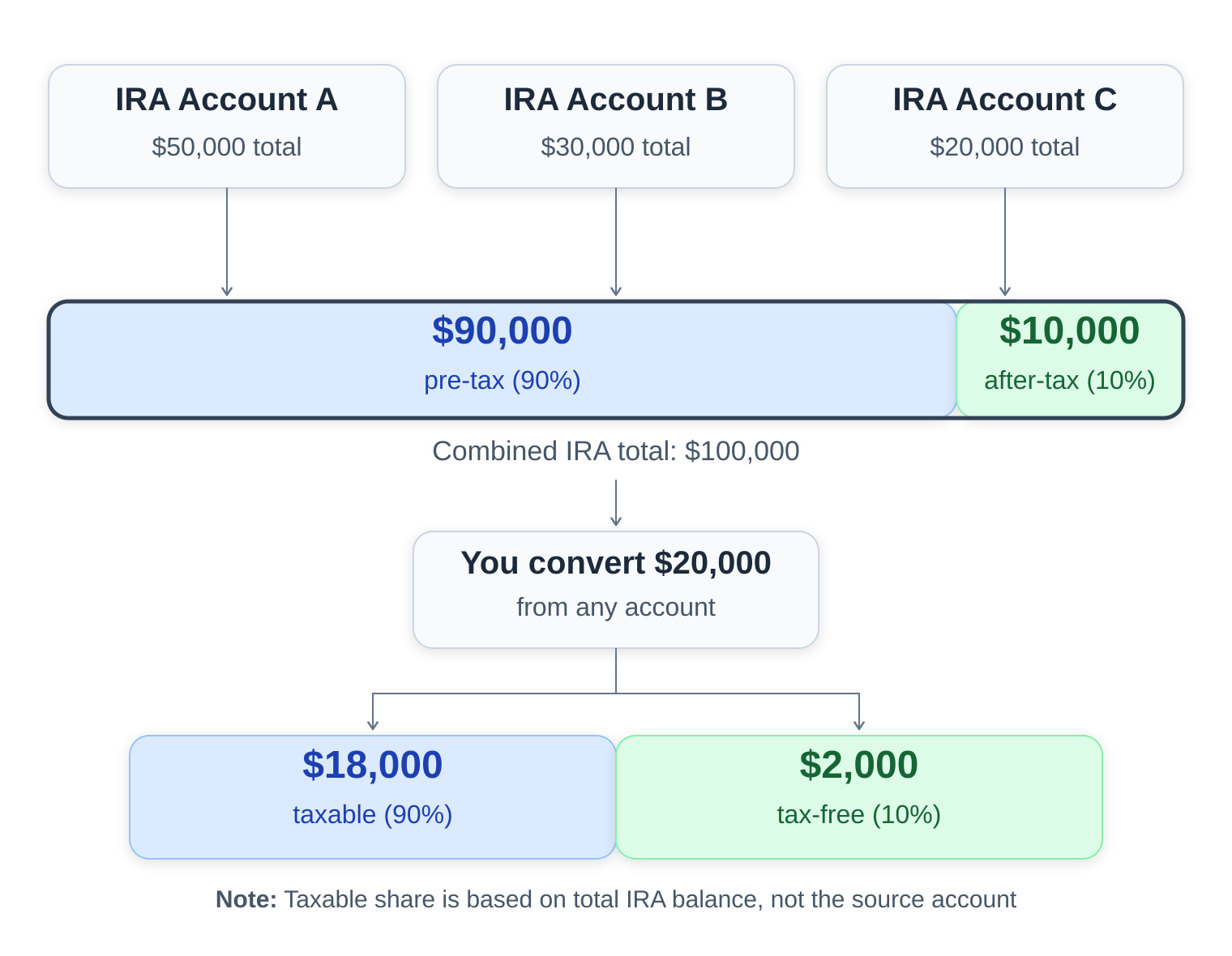
This is the straightforward version. You convert existing traditional IRA dollars, which may be a mix of pre‑tax contributions, earnings, and after‑tax (non‑deductible) contributions, into a Roth IRA. Pre‑tax dollars and earnings are taxed as ordinary income when converted. After‑tax contributions are your IRA basis, tracked on Form 8606, and here’s the wrinkle: if you have any pre‑tax money in any traditional, SEP, or SIMPLE IRA, the pro‑rata rule requires the IRS to treat every IRA you own as one combined pot. You can’t cherry‑pick only the after‑tax basis to convert tax‑free — the taxable share of any conversion is calculated against your total IRA balance, not just the account you’re converting from.
For example, say you hold $90,000 of pre‑tax money and $10,000 of after‑tax basis across three traditional IRAs for a combined IRA total of $100,000, 10% of which is after‑tax. If you convert $20,000 this year, only 10% ($2,000) comes out tax‑free; the remaining $18,000 is taxed as ordinary income, no matter which specific account the $20,000 came from.
Pro tip: If your current employer’s plan accepts rollovers, you may be able to roll the pre‑tax portion of your IRA into that plan — a non‑taxable event — leaving only after‑tax basis behind. With no pre‑tax dollars left in any IRA, the pro‑rata rule no longer applies, and converting the remainder becomes a clean Backdoor Roth (see more information below). This needs to be done in the same calendar year, and it’s important to work with a financial advisor to execute correctly.
Backdoor Roth (IRA)
This is an effective strategy for high earners whose income exceeds the limits to contribute directly to a Roth IRA. It only works cleanly if you have no other pre‑tax dollars in any traditional IRA, otherwise the pro‑rata rule above applies. You contribute after‑tax dollars to a traditional IRA, then convert them to a Roth IRA right away. Since you’ve already paid tax on that contribution, converting it immediately is generally a non‑taxable event. Be sure to report the after‑tax contribution (your IRA basis) on Form 8606 so the conversion is correctly treated as non‑taxable.
Mega Backdoor Roth (401(k) or other retirement plans)
This is designed for participants in a 401(k) plan that allows after‑tax contributions and in‑plan Roth conversions. Beyond the standard elective deferral limit ($24,500 in 2026, or $32,500 if 50+), the overall combined employee‑and‑employer 401(k) limit is $72,000 in 2026 (higher with catch‑up contributions). If your plan allows it, you may be able to contribute after‑tax dollars up to that combined cap and convert them to Roth — often the largest annual Roth conversion opportunity available to a high‑income saver. Not all plans offer this feature, so check with your plan administrator.
Pro tip: Backdoor Roth (IRA) and Mega Backdoor Roth (401(k)) strategies aren’t mutually exclusive. If you’re eligible for both, you can use them concurrently, year after year.
Common Pitfalls of Roth Conversions
Here are some common mistakes that an individual could overlook when executing Roth conversions.
The pro‑rata rule
If you have any pre‑tax dollars in any Traditional, SEP, or SIMPLE IRA, the IRS treats all of your IRAs as one combined pot when you convert. You cannot cherry‑pick only your after‑tax basis to convert tax‑free — the taxable and non‑taxable portions of the conversion are calculated proportionally across all your IRA balances. This is the single most common surprise we see with Roth conversion strategies, and it’s why we always check for outstanding IRA balances before recommending one.
Converting too much in one year
A large conversion doesn’t just get taxed at your top marginal rate — it can push other income (like capital gains) into higher brackets through the “stacking effect,” phase out of deductions and credits, and in some cases trigger IRMAA surcharges or the Net Investment Income Tax (NIIT). Also, it’s important to see if the upfront tax hit will benefit you during your lifetime, or will it impact the next generation only. It’s important to work with an advisor and CPA to review tax planning projections and weigh the tradeoffs of tax implications and portfolio benefits.
IRMAA
If you’re on Medicare (or will be within two years), a conversion increases your Modified Adjusted Gross Income (MAGI), which is what determines your Medicare Part B and Part D premiums. The long‑term benefit of a conversion can still outweigh the added Medicare cost, but it’s an expense that should be factored into the decision up front, not discovered afterward.
Paying the tax bill from the IRA itself
If you withhold taxes directly from the converted funds with your IRA, you’re not only paying tax now — you’re also converting less principal into the tax‑free Roth IRA. It’s more beneficial, and generally more efficient, to pay the tax from outside taxable savings, which preserves the full value of the conversion. And if you’re under 59½, withholding from the IRA can also trigger an early‑withdrawal penalty on the withheld amount.
Treating it as an all‑or‑nothing, one‑year decision
Given the tax implications, it’s important to review tradeoffs between various scenarios and timelines for Roth conversions. Roth conversions can be done at any point during your lifetime, so it’s important not to think of them in a vacuum and to work with your financial advisor on modeling various scenarios within your financial plan.
State taxes, especially around a move
If you’re relocating to or from a state with no income tax (e.g., Florida) or one that exempts retirement income (e.g., Pennsylvania), timing matters. Converting after you’ve established residency in a no‑tax state, rather than before, could mean the difference between owing state tax on the conversion or not.
Not filing Form 8606
This form is how you (and the IRS) track your after‑tax basis in IRAs and report conversions. Skip it, and if you convert down the line, you risk paying tax twice on contributions you’ve already paid tax on once.
The Roth conversion 5‑year rule
When people evaluate Roth conversions, the focus is usually on the tax bill up front, but it’s just as important to think through when you might need that money back. Each Roth conversion starts its own 5‑year clock, separate from any other conversion you’ve done. The withdrawal rules here are complex and beyond the scope of this post, so it’s worth discussing your specific situation with your financial advisor.
Is a Roth Conversion Right for You?
There is no simple answer given there are several factors at play, and they can have a stacking effect, but here are several moving parts to consider:
- Your current tax bracket versus your realistically expected future bracket (conversion makes sense if future bracket is higher)
- Whether you have any low‑income years on the horizon — a job transition, a gap year, retirement
- Whether you’re subject to (or approaching) IRMAA thresholds
- Whether you have other pre‑tax IRA balances that would trigger the pro‑rata rule
- Whether your current employer plan allows rollovers to shift pre‑tax assets and earnings out of your IRA and allow for future backdoor Roth strategies with no tax impact
- Your estate and inheritance goals for beneficiaries, and what tax bracket they’re likely to be in when they inherit
- Your state of residence, both now and at retirement, since state income tax treatment varies (convert when living in a low‑tax state)
The Bottom Line
A Roth conversion is a trade: tax certainty today for tax flexibility later. Done well, it can meaningfully reduce your lifetime tax bill, provide tax diversification in later years, improve portfolio growth, and provide a better after‑tax inheritance to your beneficiaries. Done without a plan, it can trigger avoidable taxes, Medicare surcharges, and hinder your financial goals.
The right answer here also isn’t static. Your tax bracket, your income, tax law, and your family’s circumstances will all keep changing, which is why a Roth conversion strategy works best as an ongoing conversation with your advisor and CPA, not as a one‑time decision. Even if 2026 is your first year weighing a Roth conversion, revisiting the decision annually is one of the few habits that can meaningfully compound your long‑term financial plan. Ask your financial advisor whether a Roth conversion strategy is right for your financial goals and tax situation.
Don’t have a financial advisor? HTG Advisors can help you navigate your Roth conversion and retirement tax planning decisions.