
This guide, prepared by HTG advisor Jennifer Hunt, CDFA®, walks through the financial steps to take before, during, and after a divorce, and how planning at each stage can help you make informed decisions and prepare for a confident fresh start.
Deciding to divorce is one of the most emotionally challenging decisions a person can make. It is also one of the most financially consequential. The choices you make in the months before, during, and immediately after a divorce can shape your financial security for decades.
At its core, the financial side of divorce is a business transaction: marital assets and debts are divided in an equitable manner, support is determined, and two households emerge from one. In the best of cases, emotions can be managed and that transaction is negotiated efficiently. When children are involved, the process is often more complicated and emotionally charged, even when both parents want what is best for their children.
That is why thoughtful divorce financial planning matters. Knowing what to expect, and what to do at each stage, can reduce stress and help you negotiate from a position of knowledge rather than uncertainty. Below, we’ve organized our divorce financial checklist into three stages: before you file, while the divorce is underway, and after it is final.
Table of Contents
- Pre-Divorce Financial Planning
- Financial Planning During Divorce
- Post-Divorce Financial Planning
- The Bottom Line: Having Someone on Your Side
Pre-Divorce Financial Planning

If you are considering divorce, the preparation you do on your own before a case is filed can have a significant influence on your outcome. Pre-divorce financial planning is about understanding your household’s complete financial picture, including what you and your spouse own and owe, and what you’ll need to live on independently.
Build a complete picture of your finances
Many people, especially those who haven’t been the primary manager of the household finances, don’t have a full view of the family’s financial life. Fear of the unknown can be more stressful than the reality. As soon as divorce becomes a possibility, begin to educate yourself by building a list of assets, liabilities, and sources of income. Our blog, Financial Clarity Helps When Considering Divorce, walks through this process in detail.
Gather key financial documents
Pulling together years of financial records can feel like a daunting task, especially during an already emotional time. You don’t need to have everything at once. The list below covers the documents you’ll likely need over the course of the divorce process, so think of it as a guide for what to start gathering or locating now. Your attorney, mediator, or financial advisor can help you fill in any gaps along the way:
- Federal and state tax returns for the last five years, including all schedules
- Recent pay stubs, W-2s, 1099s, and records of bonuses, commissions, or equity compensation such as RSUs and stock options
- Statements for bank, brokerage, and retirement accounts, including 401(k)s, 403(b)s, IRAs, and pensions
- Mortgage statements, deeds, and your most recent mortgage application, which often summarizes the household’s finances in one place
- Statements for credit cards, auto loans, student loans, and any other debts
- Life, health, disability, homeowners, and auto insurance policies
- Business records, if either spouse owns a business
- Prenuptial or postnuptial agreements, wills, and trusts
Understand your spending
Track what it costs to run your household today, then estimate what it will cost to run a separate household after divorce. These two lists become the foundation for your financial affidavit and any support negotiations.
Check your credit
Pull your free credit reports from AnnualCreditReport.com to see every account in your name, including joint accounts you may have forgotten about. If you don’t have credit established in your own name, now is the time to start.
Understand your legal options
Mediation, collaborative divorce, and litigation each carry different costs, timelines, and levels of control over the outcome. We outline the differences in The Legal Choices in Divorce.
Assemble your team
Most people benefit from three kinds of support: a divorce attorney or mediator, a CPA for tax questions, and a financial planner or Certified Divorce Financial Analyst (CDFA®). A CDFA® can model the long-term impact of different settlement proposals, so you can see how today’s decisions play out over the next 10, 20, or 30 years.
Financial Planning During Divorce
Once the case is filed and negotiations unfold, both of you must continue your day-to-day lives, complete with the associated expenses. If you have decided to live separately, new expenses come into play. Financial planning during divorce is about managing this transition carefully while building toward a fair settlement.
Know the rules that take effect at filing
The first step is filing your case with the court, which is usually handled by your mediator or lawyer. When you’ve mutually decided to divorce, this step is largely a formality: one spouse (the plaintiff) files, and the other (the defendant) is served with divorce papers.
Many states put restrictions in place at or around filing so that neither spouse can act alone on property that will be divided. These typically prohibit transferring or hiding marital assets, making significant changes to property, taking on unreasonable debt, or changing insurance policies and retirement plans. The specifics vary by state, so ask your attorney or mediator which rules apply to you.
Complete the financial affidavit
Very early in the process, each spouse is typically required to complete a financial affidavit. The court uses this document to determine support, both for temporary orders and when finalizing the divorce. The financial affidavit is a picture in time of each spouse’s current income, expenses, assets, and liabilities.
Completing it can be one of the more challenging parts of the early divorce process. Not only do you have to detail your expenses, but this private information must be shared with a mediator or lawyer and the court. It is important to be honest, thorough, and a bit thick-skinned. At the same time, it is easy to get stuck “in the weeds,” detailing every penny spent without understanding the overall picture. The good news is that in gathering these details, you are well on the way to understanding the income and expenses you’ll need to meet your financial goals.
Agree on temporary arrangements
Ideally, the two of you can agree on who will pay which expenses during this transition. If an understanding can’t be reached, the court can be petitioned to issue temporary orders that outline financial arrangements such as:
- child support.
- spousal support, and/or
- a custody schedule or child visitation.
Untangle bank accounts and bills
Identify every day-to-day expense, such as utilities and credit cards, and determine whose name is on each bill and who will pay it going forward. Keep in mind that if a household bill in your name goes unpaid, it will damage your credit score.
Joint checking accounts can create confusion, and a bounced check written by either spouse can damage both credit scores. Work with your attorney or mediator on how and when to separate joint accounts, since restrictions on moving marital funds may apply.
Plan for the marital home
During separation, one spouse often remains in the marital home while the other finds housing elsewhere. Agree on how the costs of this asset will be handled, including the mortgage, property taxes, insurance, maintenance, and utilities. One strategy is to keep a detailed record of who pays what and settle the difference when the divorce is finalized, though this assumes each of you has the cash flow to cover costs in the meantime.
If the home will be sold, timing matters. The IRS home sale exclusion generally allows up to $250,000 of gain to be excluded for a single filer, versus up to $500,000 for a married couple filing jointly. Learn more in Will You Owe Tax on the Sale of Your Primary Home?
Children and pets
Depending on the custody arrangement, there may be additional costs for children and pets. One solution is to open a joint account for these extraordinary expenses, with each spouse depositing an agreed-upon amount. Expenses such as camps, computers, doctors’ appointments, or new clothes come out of the account, and when funds run low, each parent deposits another equal amount.
Look beyond face value when dividing assets
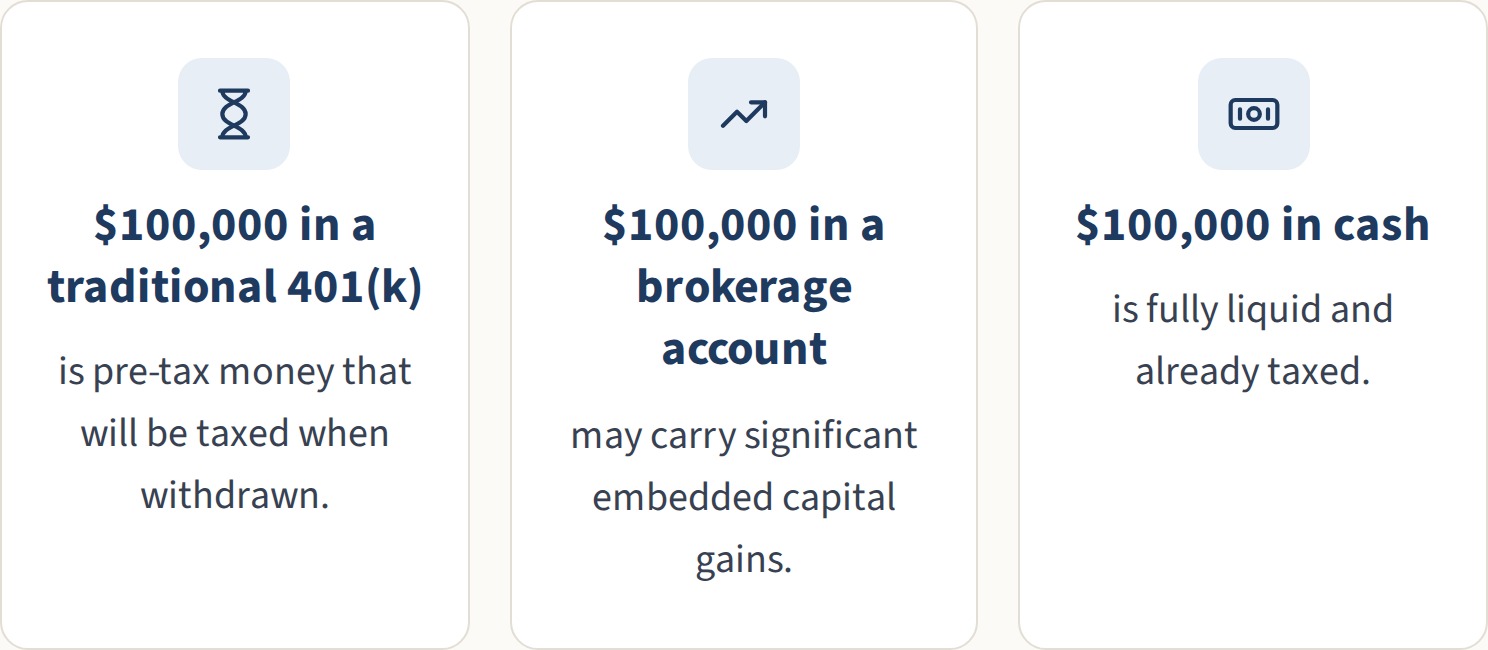
Not all dollars are equal. $100,000 in a traditional 401(k) is pre-tax money that will be taxed when withdrawn. $100,000 in a brokerage account may carry significant embedded capital gains. $100,000 in cash is fully liquid and already taxed. Transfers of property between spouses as part of a divorce are generally not taxable events, but the receiving spouse typically takes on the original cost basis, and with it any future tax bill.
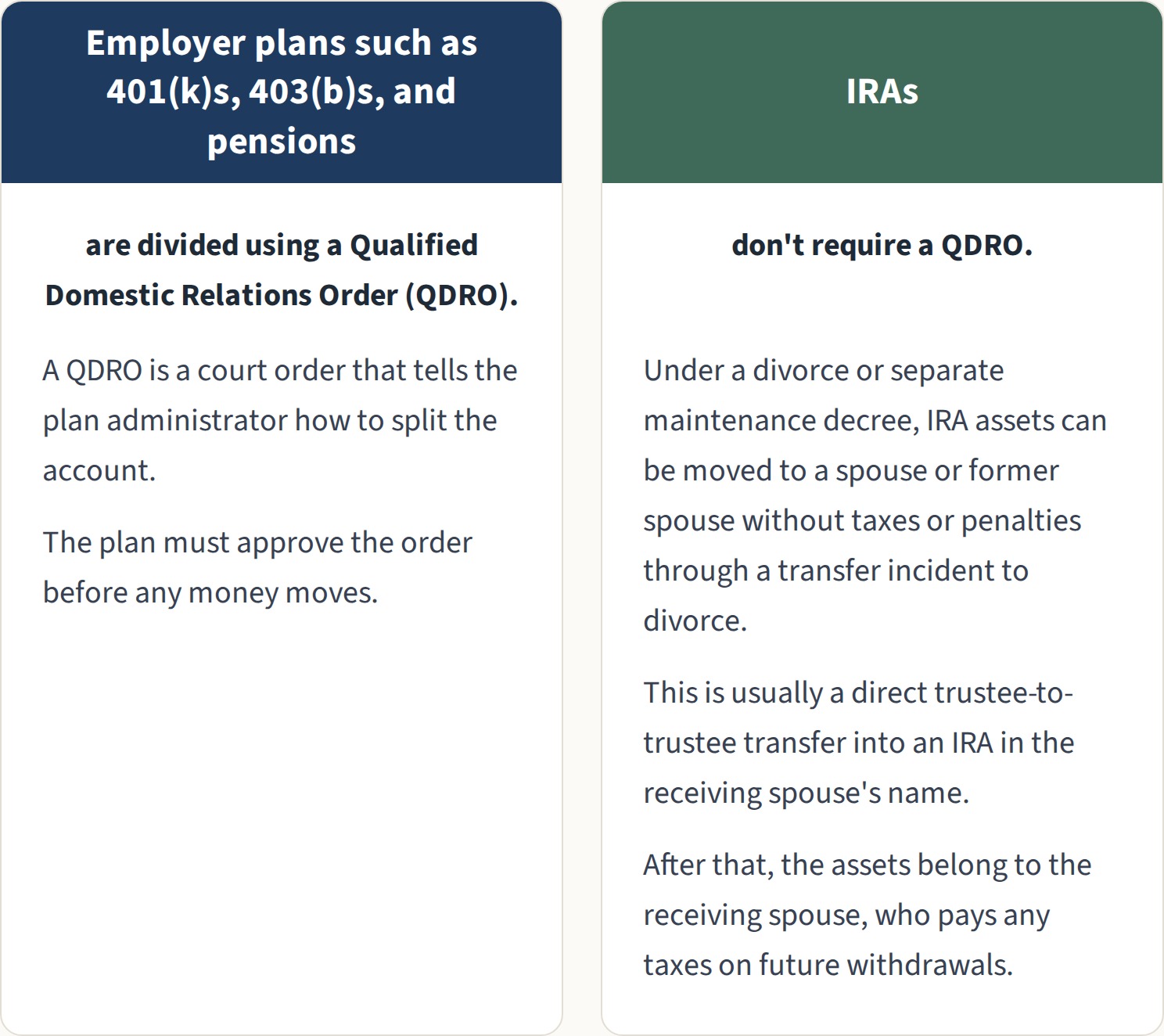
Retirement accounts are often among the largest assets divided in a divorce, and the process depends on the type of account.
If you are covered under your spouse’s employer plan, COBRA typically allows a former spouse to continue coverage for up to 36 months, and marketplace coverage under the Affordable Care Act is another option.
Post-Divorce Financial Planning

Once the settlement has been agreed upon, financial planning after divorce can begin in earnest. The first priority is making sure the terms of the agreement are carried out. The second is building a plan that reflects your new life: setting goals, creating a budget, and investing toward your financial independence.
Implement the settlement
Retitle accounts, deeds, and vehicles as required by your agreement. If one of you is keeping the home, that spouse will typically need to refinance the mortgage in their name alone. Removing a name from the deed does not remove that person from the loan, so without a refinance, both of you remain responsible for the payments, and a missed payment can affect both credit scores. Submit any QDROs to plan administrators promptly, since delays can create complications. Close any remaining joint accounts and credit cards.
Update beneficiaries and your estate plan
Beneficiary designations on retirement accounts, life insurance, and transfer-on-death accounts typically override your will, so it is very important to review the beneficiaries on each account. Your settlement may require you to keep your former spouse as beneficiary on certain policies that secure support, so check your agreement first. Then update your will, powers of attorney, and healthcare directives.
Review your insurance
Life insurance may be needed to protect child support or alimony. Disability insurance may be more important now that you rely on a single income. Homeowners and auto policies should be in your own name.
Reset your tax picture
Note that your tax filing status is determined by your marital status on December 31, so the timing of your final decree affects how you file for that year. Also, going forward, your filing status will change, so update your Form W-4 with your employer using the IRS Tax Withholding Estimator. If you are the custodial parent and have agreed to let your former spouse claim a child, that is typically documented with IRS Form 8332.
Rebuild your budget and emergency fund
Your post-divorce spending plan will likely look very different from your married one. Revisit the estimates you made before filing and compare them with your actual expenses. It is also important to rebuild an emergency fund in your own name.
Plan for retirement and Social Security
Your retirement timeline may need to shift based on the assets you received and the income you now have. If your marriage lasted at least 10 years and you have not remarried, you may be eligible for Social Security benefits based on your former spouse’s record once you reach age 62. However, while you can claim at age 62, it is a reduced amount, so if feasible we encourage waiting until your full retirement age.
Revisit your investment strategy
Your time horizon, risk tolerance, and income needs have likely changed, and your portfolio should reflect that. Our blog A Fresh Financial Start After Divorce offers more ideas, and our investment management team can help you align your investments with your new goals.
The Bottom Line: Having Someone on Your Side
Whether from a financial or an emotional point of view, divorce is not easy. Newly separated, the decisions you must make can feel daunting to face alone. Friends and family can be instrumental as sounding boards and sources of support, and your divorce attorney, who will come to know more about you than you imagined anyone would, is there to guide you through the legal process.
On the financial side, a financial planner or Certified Divorce Financial Analyst (CDFA®) can work alongside your attorney or mediator to compile the information you need, evaluate settlement options on an after-tax, long-term basis, and help you reach a fair financial outcome. Then, once the settlement is final, that same advisor can help you set goals, build a budget, and invest toward your financial independence, understanding that your needs will continue to change in the years after your divorce.
Whether you are just beginning to consider divorce, in the middle of negotiations, or starting your next chapter, HTG Advisors’ divorce financial planning team, including a CDFA®, can help you move forward with clarity and confidence.