
In this article, Robin Sherwood, CFP®, a Connecticut-based Principal at HTG Advisors, explains how dividends, interest, and capital gains are taxed, and walks through the strategies we use to help clients keep more of what their portfolios earn.
Most investors keep a close eye on their returns. Far fewer look at what those returns are worth after taxes.
That’s a costly blind spot. Two investments can earn the same return and leave you with very different amounts, depending on how the income is taxed. For high earners, a dividend can be taxed federally at 23.8% or 40.8%, depending on whether it’s qualified. That’s a 17-percentage-point gap on the same dollar of income.
The good news is that much of this is within your control. Which funds you choose, how long you hold them, and which accounts you hold them in can all change what you owe, without changing your overall investment strategy.
Let’s walk through how each type of investment income is taxed, and more importantly, strategies that can be employed to improve the tax efficiency of your portfolio.
Table of Contents
- Four Ways Your Portfolio Grows
- Dividends: Not All Are Created Equal
- What’s the NIIT Tax?
- Interest Income: Where You Live Matters
- Capital Gains: Timing Is Everything
- Strategies We Employ to Improve Tax Efficiency
- The Bottom Line
Four Ways Your Portfolio Grows
Your investments generate income in four basic ways:
- Dividends (from stocks, ETFs, mutual funds, or Real Estate Investment Trusts (REITs))
- Interest (from bonds)
- Capital gains (when investments increase in value)
- Business income (from partnerships)
Each type gets taxed differently. Let’s break it down.
Dividends: Not All Are Created Equal
A dividend is a payment a company makes to its shareholders, usually in cash, as a way of sharing its profits. If you own a mutual fund or ETF, the fund collects dividends from the companies it holds and passes them along to you. You owe tax on dividends in the year you receive them, even if you automatically reinvest them.
Dividends fall into two categories: qualified dividend income (QDI) and non-qualified dividend income (NQDI).
Qualified dividends get taxed at lower rates, but only if they meet these requirements:
- The shares must have been held for a required minimum time, typically at least 61 days during the 121-day period surrounding the ex-dividend date.
- The dividend must be paid by a U.S. corporation or a qualifying foreign corporation.
Non-qualified dividends get taxed at your regular income tax rate, which can be much higher.
Here’s the kicker: the tax rate difference can be as much as 17 percentage points!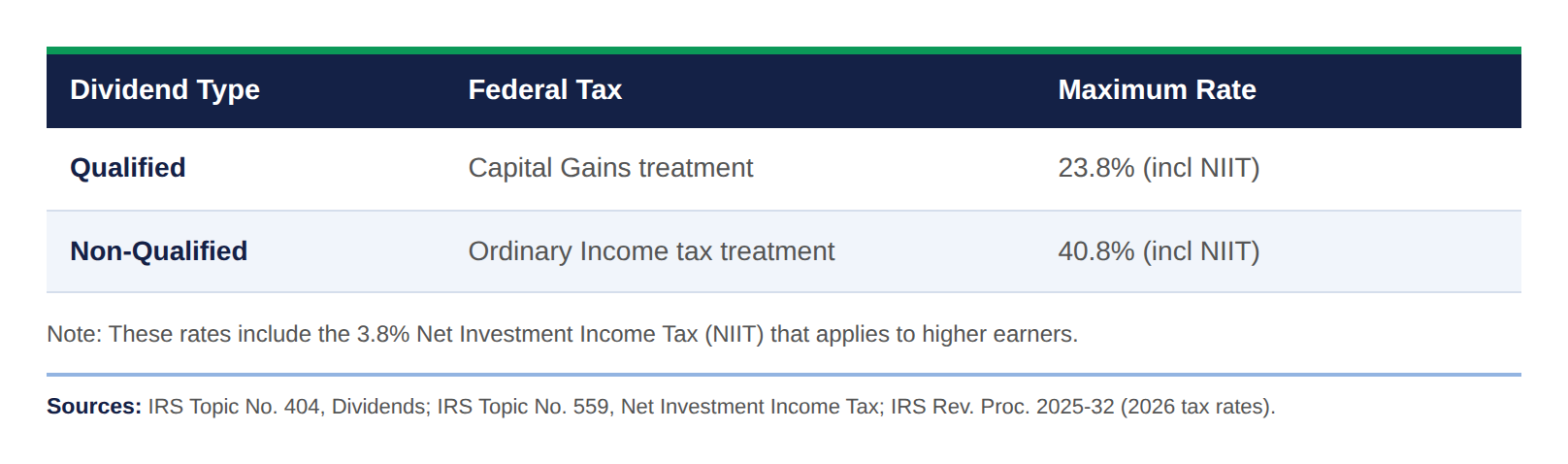 Even if you own a mutual fund or ETF, the dividends keep their “qualified” or “non-qualified” status based on how the fund trades. Funds that trade frequently without paying attention to holding periods can turn qualified dividends into non-qualified ones—costing you money. Index funds that are tied to an index may not have the flexibility required to avoid this consequence.
Also worth knowing: most income from REITs and partnerships doesn’t qualify for the lower rate. Ordinary REIT dividends do get a partial break, though: a 20% deduction under Section 199A, made permanent in 2025, which lowers their top federal rate to 29.6% (33.4% with NIIT), compared with 40.8% for other non-qualified income.
What’s the Net Investment Income Tax (NIIT)?
This is an additional 3.8% tax added only to certain types of investment income (dividends, interest, capital gains and non-qualified annuity distributions, plus rents, royalties, and passive business income), for taxpayers who exceed an overall income threshold. NIIT thresholds are not inflation adjusted and are based on Modified AGI (MAGI). For 2026, these thresholds are:
- $250,000 (married filing jointly or qualifying surviving spouse)
- $200,000 (single or head of household)
- $125,000 (married filing separately)
The tax applies to the lesser of your net investment income or the amount by which your MAGI exceeds the threshold.
Interest Income: Where You Live Matters
Interest is what you earn for lending your money. When you buy a bond or open a CD or savings account, you’re lending money to a government, a company, or a bank, and they pay you interest in return. Unlike dividends, interest doesn’t get a lower qualified rate; all interest except tax-exempt municipal bond interest is taxed as ordinary income, at a maximum federal rate of 40.8% (37% plus the 3.8% NIIT). The bigger differences show up in state taxes, which vary depending on who issued the bond.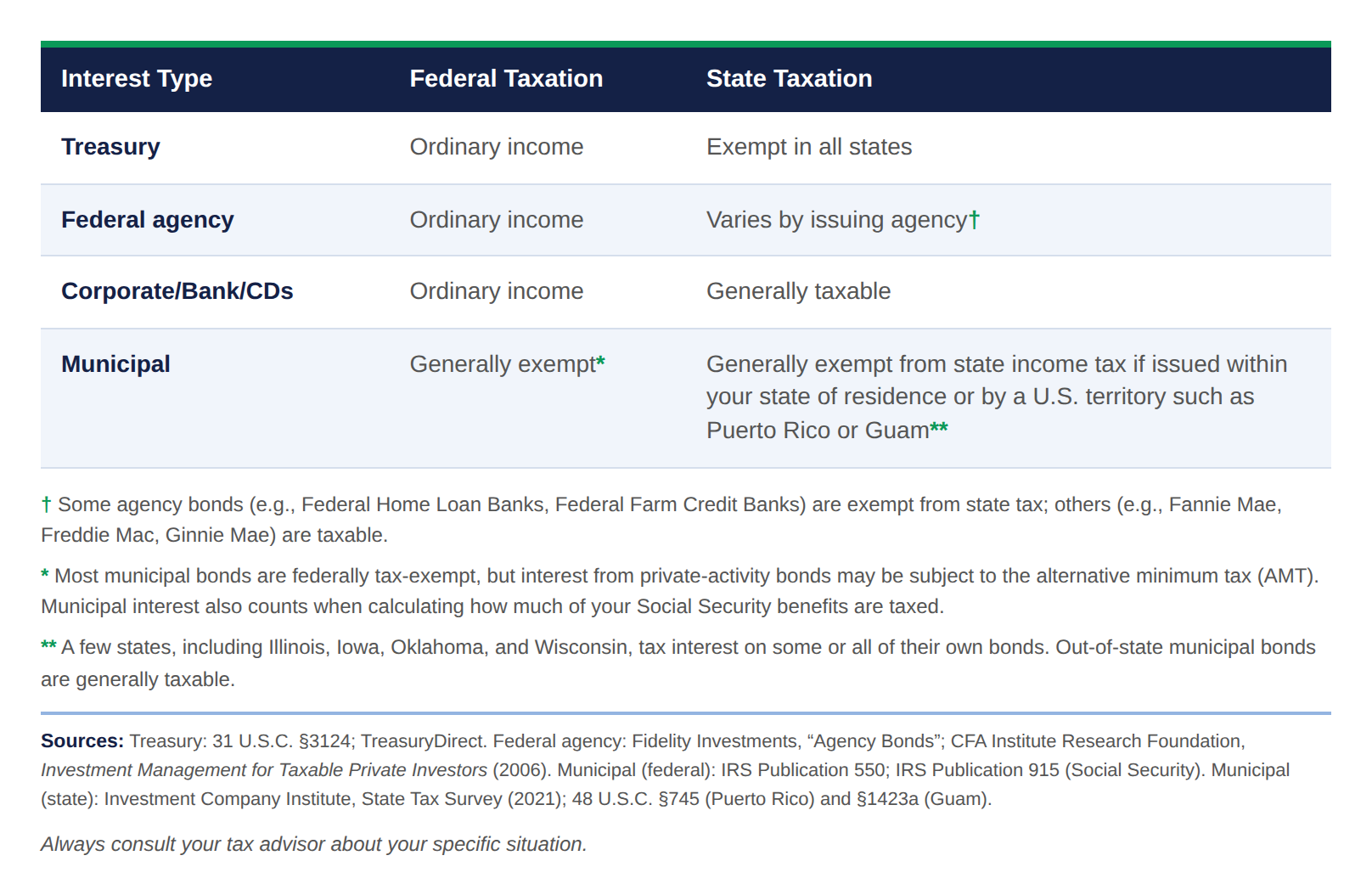
Capital Gains: Timing Is Everything
A capital gain is the profit you make when you sell an investment for more than you paid for it. If you buy a stock for $10,000 and later sell it for $15,000, you have a $5,000 capital gain. You generally don’t owe tax on that gain until you sell, which gives you some control over when you pay. If you own a mutual fund or ETF, though, the fund may pass along capital gains through distributions, and you’ll owe tax on those even if you didn’t sell anything.
As with QDI, long-term capital gains (held more than 1 year) are taxed federally at a lower tax rate than ordinary income (23.8% vs the max of 40.8%). However, some taxpayers in low brackets will pay 0% on their capital gains. Unfortunately, capital gains brackets don’t follow ordinary income tax brackets; they have their own distinct brackets.
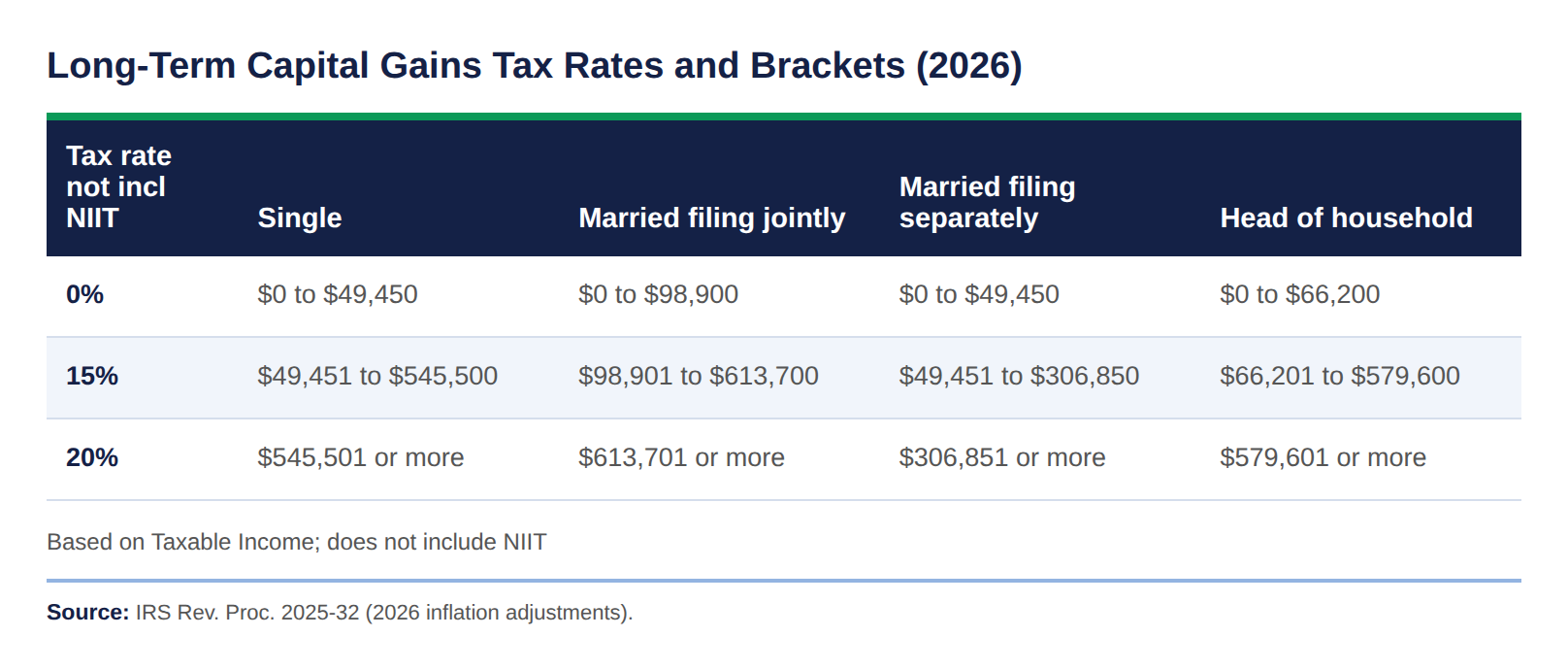 As with QDI, capital gains are subject to NIIT.
Short-term capital gains (held one year or less) do not enjoy this preferential tax treatment and are taxed at ordinary income tax rates, which means as high as 40.8% (37% plus the 3.8% NIIT).
Strategies We Employ to Improve Tax Efficiency
At HTG Advisors, we work with our clients to build tax-efficient portfolios that still reflect their goals and risk tolerance. Here are some of the strategies we use:
Choose tax-efficient funds
We select ETFs and funds that trade carefully to minimize taxable events. This means avoiding trades during dividend periods in order to generate qualified dividend income and keeping turnover low to reduce gain distributions.
Smart account placement
We put investments that generate high non-qualified income (like REITs and high-yield bonds) in tax-deferred accounts (IRAs, 401(k)s). Investments with qualified dividends and capital gains go into taxable accounts where they get better tax treatment.
Avoid short-term gains
We carefully track which lots/shares we’re selling to avoid triggering short-term capital gains whenever possible.
Know your tax bracket
We request your tax return every year to ensure that we are informed on your tax bracket. If you are in a low bracket, we may proactively recognize gains, and if you are in a high bracket we will consult with you on the advisability of taking gains.
Municipal vs. taxable bonds
Tax-free sounds great, but it’s not always the best deal. If you’re in a moderate tax bracket (say, 22%), taxable bonds might leave you with more money after taxes. We compare both options regularly to find what’s best for you.
The Bottom Line
Building a good portfolio starts with smart investment choices. But managing it well means paying attention to taxes year-round, so you actually keep the returns you earn.
HTG Advisors can help you look at your portfolio through a tax lens, coordinating your investments with your broader tax planning and overall financial picture.
Ready to talk through how taxes fit into your investment strategy?